
What is Imperative Programming?
Imperative Programming is an approach to be used in the development of applications. It is different from any other technique as it focuses on the steps capable of performing any change in the current state of the software. The approach involves using statements that can change the state of the program.
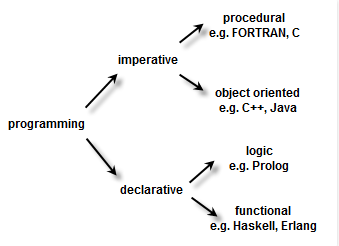
Another requisite of this tactic is that the developer needs to code from scratch to end while solving a problem, which means it is impossible to use any existing modules. This is also different from declarative programming because it concentrates on how the program should accomplish the operation, while declarative programming's primary focus is what will be the functions of the program.
It is similar to natural language; the commands in imperative programming are shown as imperative mood. An imperative program constitutes multiple such commands that provide instruction to the system about how the actions are to be performed. The commands from the Central Programming Unit itself are imperative.
In imperative programming, all the commands are first converted into binary equivalent. The computer directly understands the binary code and is more efficient in running. The aim behind introducing this approach was to develop a method to develop software that is easier to understand by humans. The code in the imperative program can be broken into several blocks, which makes it easier to comprehend. Some programming languages that implement this approach are C++, Java, and C#.
The idea of dividing a larger code into smaller parts or blocks was executed in the ALGOL programming language in the 1950s for the first time. Later these smaller executable blocks came to be known as compound statements. But nowadays, we call them procedures instead of compound statements. The procedure may be a single command or can constitute multiple imperative commands, but once the block is established, the whole procedure is used as a single imperative statement.
This allows the developer to be abstract the control flow of the program. It makes it more natural to implement the various concepts of programming in this method as compared to any other approach. It provides a higher level of data abstraction than provided in declarative programming.
How is Imperative Programming different from Declarative Programming?
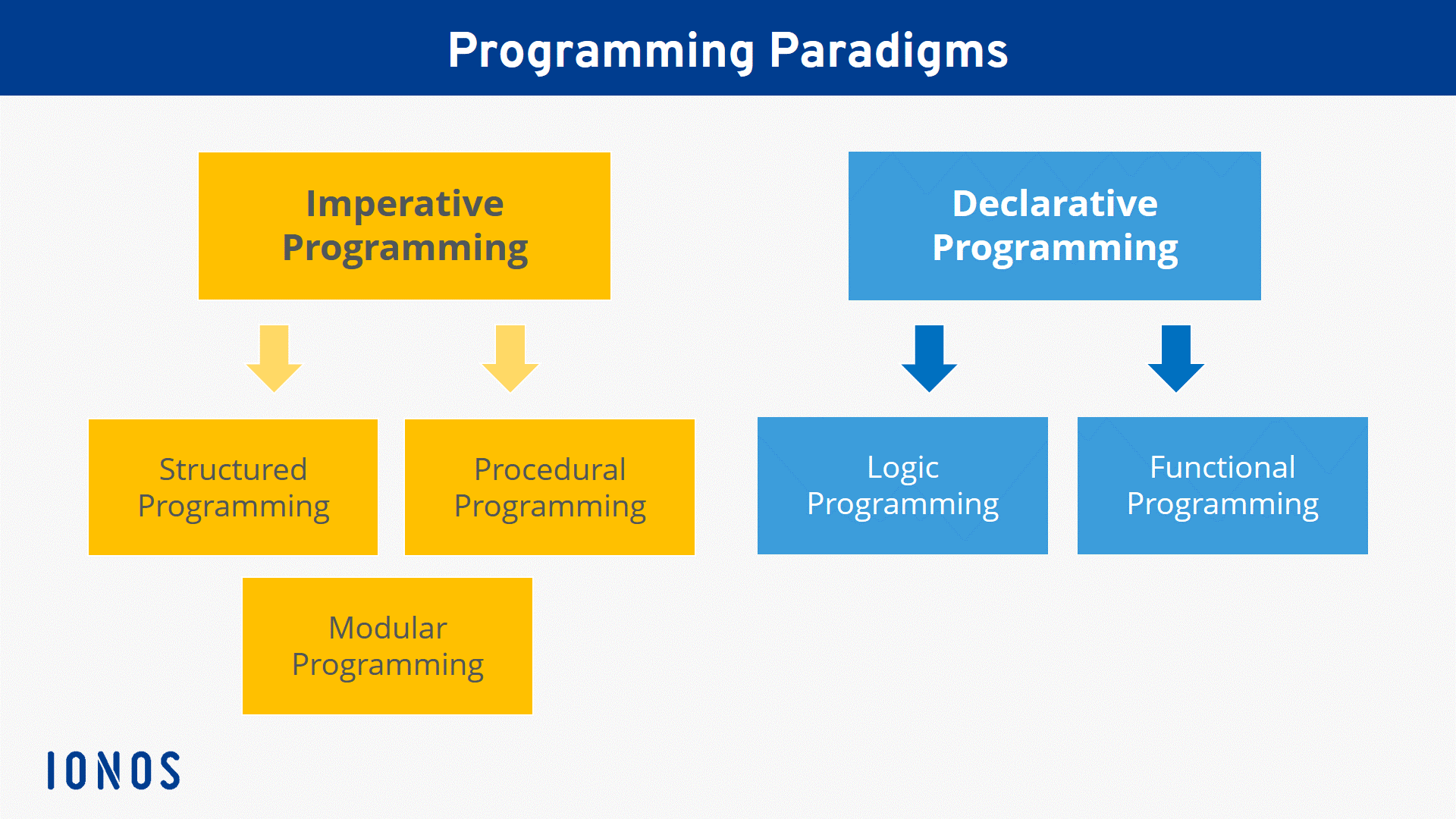
- In declarative programming, the developer is required to define the entire problem; instead, in imperative programming, the developer must focus on stating various issues that will be solved. When using the declarative programming approach, there is no restriction on the steps or methods used to solve the problem, but the approach ensures that the solution is correct. This approach is also called the model-based programming approach. This is called so because the languages that implement this approach instruct a strict method to solve the problem at hand using various models. The programming languages that fall under the category of declarative programming are HTML, CSS, SQL, and various other logical or domain-specific languages.
Let us discuss a real-life scenario to better understand the difference between imperative and declarative programming approaches.
- Consider an example of delivering a courier, and the declarative programming is similar to the address on the package. It will declare the exact location you are required to send the package. Still, the imperative programming is like your navigator that will provide you with step-by-step instructions to arrive at your destinations. The models used for the functioning of declarative programming are constructed from the imperative programming.
- The developer uses numerous mutable variables to implement the solution, which has caused a lot of issues. At the same time, in declarative programming, there is no need to use mutable variables, which means there are no issues. In the imperative approach, the decision-making power lies in the hand of the developer, while in declarative programming, the decisions and the commands are given by the compiler.
- When developing an application using low-level programming languages, the developer prefers to have maximum control over the language; full control is provided to the developer in imperative programming.
- While declarative programming can make the code more understandable, this approach also allows for automating the repetitive process. This is usually preferable among beginners.
- Procedural programming is an example where the imperative approach is followed. In the approach, there are various limitations because of the stepwise implementation and singular flow of the code. This makes it difficult to extend the usability and low room for abstraction. While in the declarative approach, numerous features are advantageous to the developer. It provides a higher level of abstraction, and the entities are used as objects. The programs can easily be extended and can also implement parallel processing. All object-oriented programming falls under the declarative programming approach. Some examples of programming languages are C, C++, Java, Python, Basic, PHP, MATLAB, Ruby, and many more.
Advantages and Disadvantages of implementing Imperative Programming
- Though imperative programming is a primitive technique, various programming languages still implement this approach. And this is the actual form of the programming. Therefore, more certain features are provided in the imperative programming, which makes it more suitable than existing models.
- The imperative programming approach is simpler to implement comparing with another programming approach, and it is easier to learn because of its simpler step-by-step implementation. Most programmers begin their programming journey by learning an imperative language first. When working on a routine task, the solution should be as clear as possible. Moreover, any change should take little or very low effort in such a situation. It is always better that multiple people can maintain or change the application. The process of maintenance and optimizations should not be limited to only one person. It is most suitable for solving small problems, but the problem that arises when solving complex problems lies behind the size of the code. The line of the code increases drastically when the user solves complex problems. The size of the code increases, but it is still more understandable.
- The execution itself is declarative, making it harder to differentiate the execution from the programming. Due to this, there is a strong possibility of an error that can be caused due to the constant interventions. If the program's code is fully based on an imperative approach, then it is very difficult to implement extensions. At the same time, in the declarative approach, the code is divided into blocks, so it is easy to add extensions separately.
| Advantages | Disadvantages |
| The biggest advantage of imperative programming is that the code is easily understandable. | If the problem is complex, the size of the code increases drastically. |
| The language is easier to learn for beginners. | There is always a possibility of errors due to subsequent access to the code. |
| The whole control is with the developer, so certain characteristics of the application can be taken into account. | It is difficult to extend the application due to the rigid nature of the code. |