
What is SMPS: Switch Mode Power Supply
Switched-mode power supplies, typically known as SMPS, are the power source that uses a switching regulator to control and stabilize the output voltage by turning on and off the load current. The overall power loss is decreased, and the power conversion is higher with these power supplies. Electricity is transformed by an electronic circuit known as a switched-mode power supply (SMPS), employing switching components that are turned on and off at high frequencies. Power is provided to the switching device by storage components like inductors or capacitors when it is in its non-conduction mode.
Computers and other sensitive devices that require a steady and effective power supply frequently employ switching power supplies because of their great efficiency. The SMPS is used to change AC voltages to DC voltages. The SMPS utilizes a current supply ranging from 220 to 240.
If 240 volts of power supply are ever delivered to the computer system, all the components linked to the SMPS will suffer serious damage or even risk burning themselves. Therefore, the computer requires a DC power supply to operate and function independently.
The computer's SMPS is linked to the motherboard, and since all devices are connected via the motherboard, power is supplied from the SMPS to the motherboard, where it is transferred to all of the system's attached devices.
Other names for switched-mode power supplies include switch-mode power supplies and switching-mode power supplies.
Input and output voltage types are used to categorize switched-mode power supply. The four main groups are as follows:
- AC to DC
- DC to DC
- DC to AC
- AC to AC
An isolated AC to DC switched-mode power supply parts are as follows:
- Rector and filter at the input
- MOSFETs and other switching components are used in inverters.
- Transformer
- Output filter and rectifier
- Circuit with feedback and control
The switching MOSFET or power transistors in the inverter use an input DC supply from a rectifier or battery to turn the input DC supply on and off at high frequencies between 20 kHz and 200 kHz. High-frequency voltage pulses are applied to the transformer's primary winding by the inverter, and the secondary AC output is rectified and smoothed to produce the required DC voltages. A feedback circuit controls the control circuit to adjust the duty cycle while monitoring the output voltage to maintain the output at the desired level.
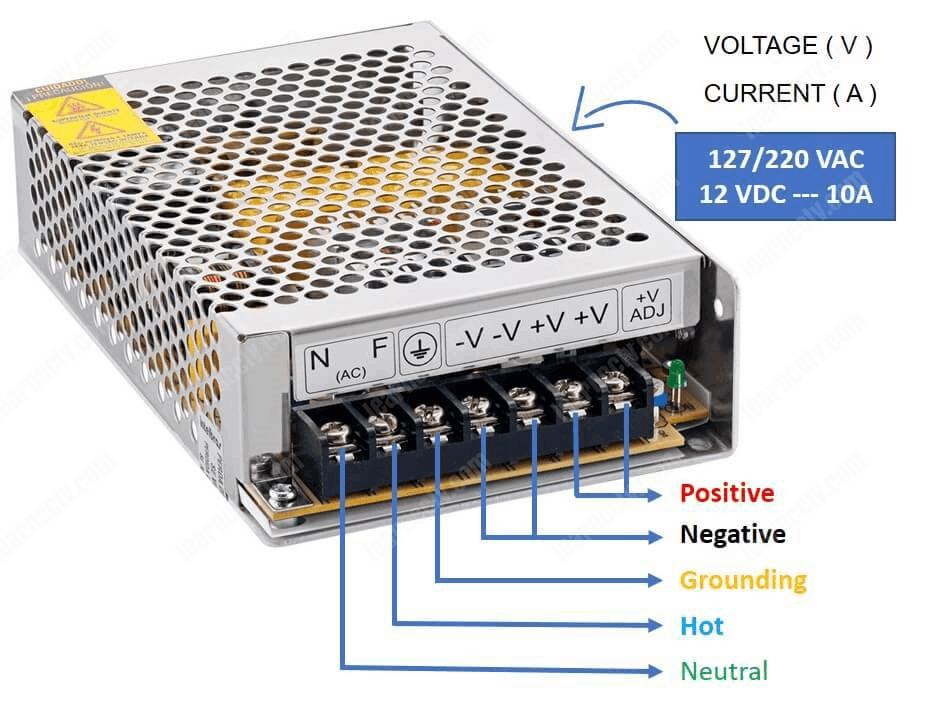
The various topologies of circuits, each with their special features, benefits, and modes of operation, dictate how input power is transported to the output.
A transformer is a key component in the most widely used topologies, including flyback, push-pull, half-bridge, and full bridge. It offers isolation, voltage scaling, and numerous output voltages. The power conversion in the non-isolated versions is accomplished through inductive energy transfer rather than a transformer.
SMPSUs have the following benefits
- Increased effectiveness from 68% to 90%
- No matter how the input supply voltage varies, the outputs will be controlled and reliable.
- Lighter and smaller
- Innovative technology
- A lot of power density
Disadvantages
- electromagnetic interference is produced
- Intricate circuit design
- More expensive than linear supply
Computers, delicate electronics, battery-operated gadgets, and other equipment demanding exceptional efficiency are all powered by switched-mode power sources.
Types of SMPS
The SMPS {Switch Mode Power Supply} is divided into four types.
- DC to DC Converter
- Forward Converter
- Flyback Converter
- Self-Oscillating Flyback Converter
DC to DC Converter
A high-voltage DC is created by rectifying and filtering the power generated by the a/c voltage. The step-down transformer's primary side is then fed with this high DC voltage after it has been turned.
Forward Converter
The choke in the forward converter carries the current whether or not the transistor is operating. The transistor's diode maintains the energy flow with the tonnes by supplying current during the OFF time. The choke stores the energy and transfers a portion of it to the output lots during the on phase.
Flyback Converter
The inductor's magnetic field stores power in a flyback converter while the button is turned on. When the switch is open, the power is cleared into the outcome voltage circuit. The resulting voltage identifies the Flyback converter's Duty cycle.
Self-Oscillating Flyback Converter
It is founded on the Flyback theory. A present through the transformer primary rises linearly with the slope Vin/Lp during conduction.
The quick recovery rectifier begins to run reverse-biased and maintains the conducting transistor ON due to the voltage induced in the response and secondary winding.